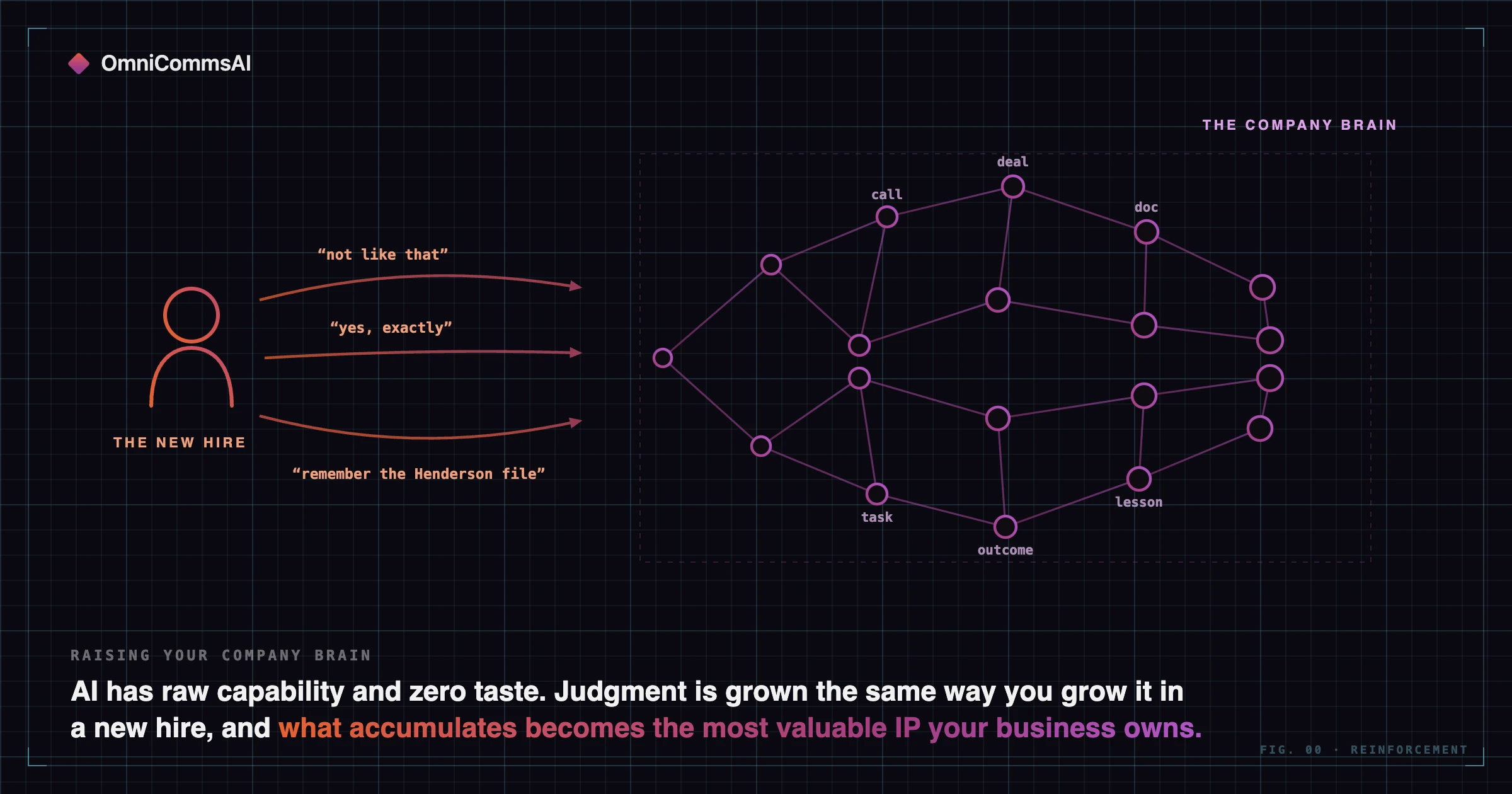
AI today is intelligent but it has no judgment. It can write the email, draft the proposal, summarize the call, fluently and instantly, at a level that would have looked like magic five years ago. What it can’t do out of the box is know which of those is right for your business. It has raw capability and zero taste.
Neither does your best new hire on their first Monday.
Think about the last person you brought on. Sharp, credentialed, genuinely capable. They can write, reason, and act. And on day one they don’t know that you never interrupt this particular customer, that this account gets a call and not an email, that “we never discount before the pilot,” or that when the title company goes quiet you call the escrow officer directly instead of waiting another day.
None of that was in the job description. Almost none of it is written down anywhere. They learn it the only way anyone learns judgment: reinforcement over time. Do the thing, see the reaction, adjust. A few hundred small corrections over the first ninety days, “not like that,” “yes, exactly that,” “remember what happened on the Henderson file,” compound into instinct, taste, and the specific standards of your business.
That is exactly how you build a Company Brain. You don’t program judgment into AI. You train it the same way you train a person, through continuous reinforcement on top of a memory that never forgets, until it mimics your tendencies, your standards, and your hard-won lessons.
Intelligence is rented. Judgment is grown.
The intelligence is a commodity. Anyone can rent a capable model tomorrow. What nobody can rent is your company’s accumulated judgment, the ten thousand tiny decisions that make your business run the way it runs.
That judgment only forms through a loop: the AI acts, a human (or an automated check) reinforces with a rating, a correction, or a “do it this way instead,” and the system re-weights what it believes based on what actually worked. Same as the new hire. Same as anyone who has ever gotten good at a job.
        THE NEW HIRE                       THE COMPANY BRAIN

   act ──► you react                  act ──► you react (rate / correct /
    ▲          │                       ▲       "do it this way")
    │          ▼                       │                    │
   tries    "not like that,"        next time               ▼
   again ◄─  "yes, exactly"          it's better ◄──  re-weight the exact
             ninety days                              lessons behind the outcome
                                                        a thousand times

        ⇒ judgment, taste, standards      ⇒ your business's judgment, encoded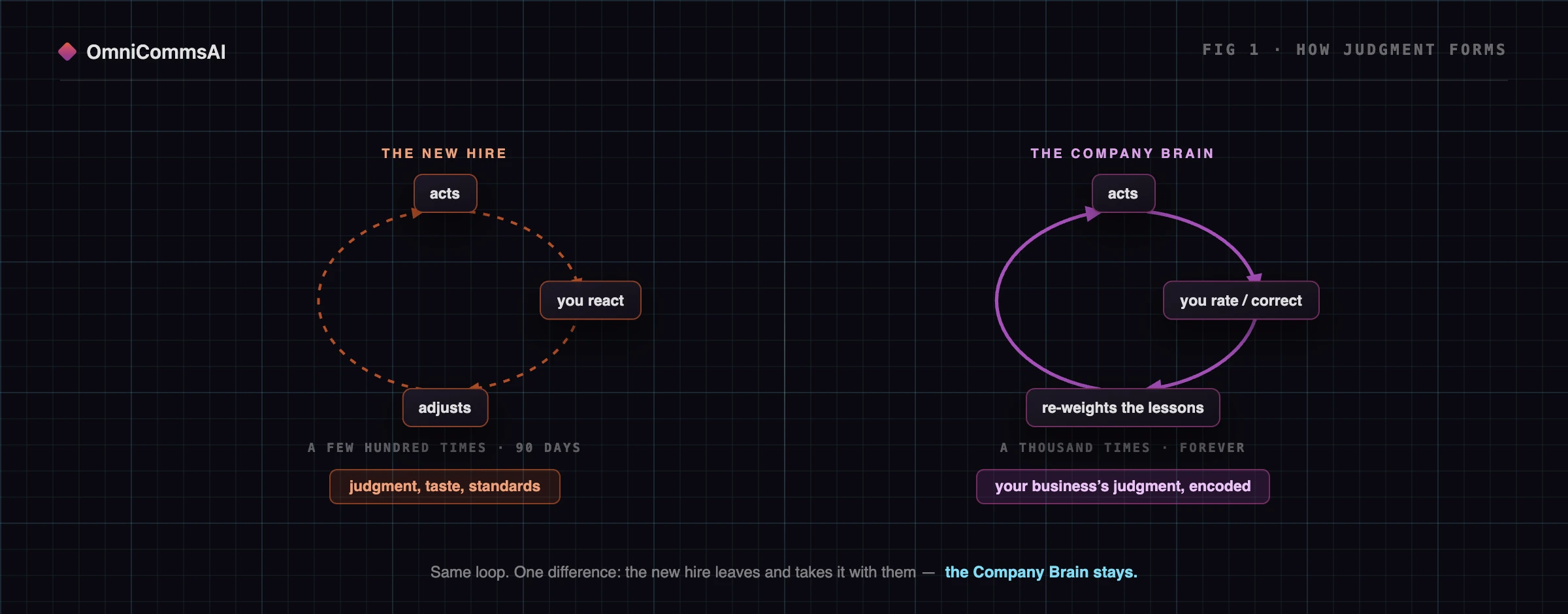
There is one difference between the two columns, and it is the whole argument for building the right one. Your new hire eventually leaves, and the judgment you spent ninety days installing walks out with them. You start over with the next person and pay for those ninety days again. The Company Brain is the first version of that investment that stays.
You cannot reinforce what you never captured
Here’s the trap most businesses are walking into: reinforcement is impossible without a record. You can’t reward or correct a decision you didn’t keep. If the call, the draft, the outcome, and the correction all evaporated into a throwaway chat window, there is nothing to learn from and nothing to learn onto.
This is why the memory layer has to come first, and why it can’t be a pile of notes. To reinforce judgment over years you need every piece of business activity captured as connected, provenance-rich memory, meaning and structure, on a substrate that expands without bloating:
- every conversation, document, deal, task, and outcome, stored as typed nodes
- linked to each other with weighted relationships
- each carrying where it came from, so a lesson can be traced and trusted
- and each carrying a weight that feedback can tune
Miss this, and the learnings are gone the moment they happen. You can’t reconstruct three years of judgment after the fact, because the raw material no longer exists. If you don’t start capturing everything now, on a memory built to hold it, the Company Brain is simply not recoverable later. There’s no shortcut, no backfill. The only way to have five years of accumulated judgment five years from now is to start capturing it today.
   CAPTURE EVERYTHING (now)                 CAPTURE NOTHING (chat windows)
   ┌───────────────────────────┐            calls ── gone
   │ semantic + graph memory   │            drafts ─ gone
   │  ◦──◦──◦──◦  (weighted)   │            lessons ─ gone
   │  provenance on every node │                │
   └───────────┬───────────────┘                ▼
               │ feedback tunes weights     "let's rebuild our
               ▼                              judgment" ── impossible.
      a brain that compounds                  nothing to rebuild from.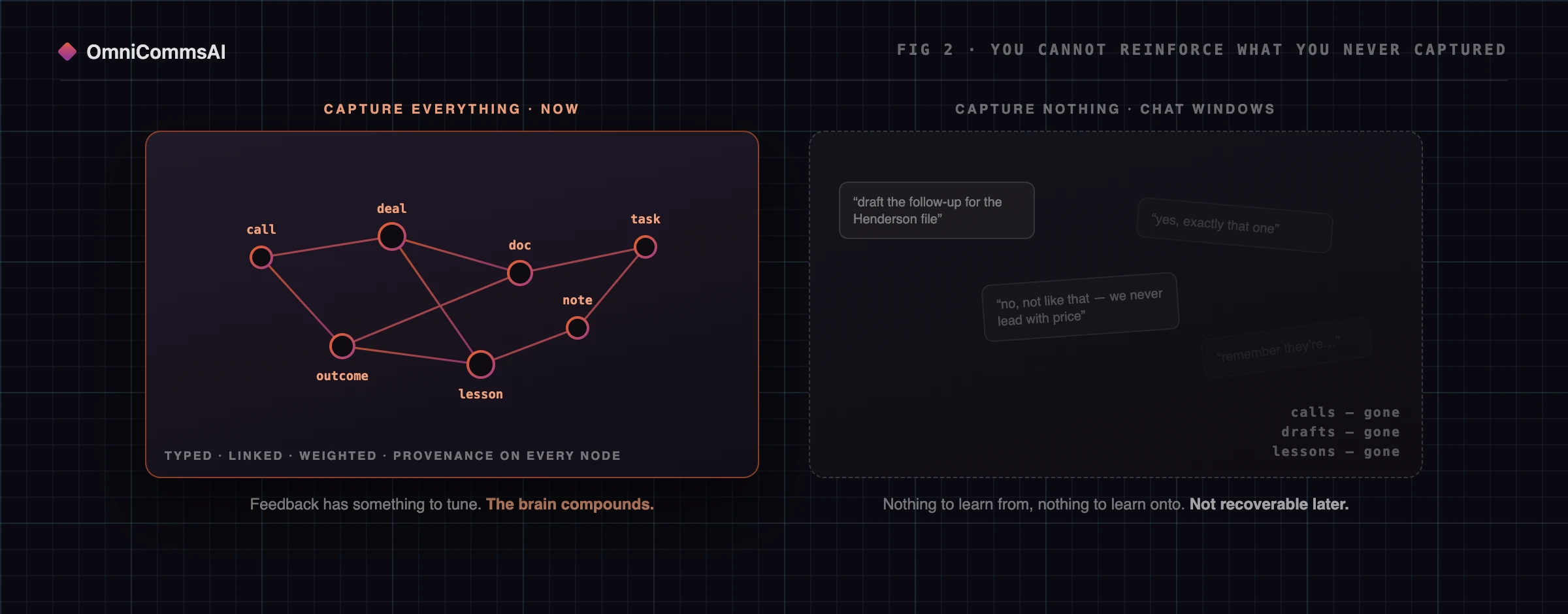
Over time, the brain becomes the business
Play this forward. Year one, the Company Brain knows a little. Year three, it has absorbed tens of thousands of reinforced decisions and it handles most routine judgment the way your best people would. Year five, it is the operating knowledge of the company: the accumulated taste, playbooks, relationships, and lessons of everyone who ever worked there, alive and queryable and still learning.
At that point the Brain isn’t a tool the business uses. It’s the value center of the business itself. Buildings depreciate, software gets replaced, staff turn over, but a compounding, self-improving record of exactly how your company wins is the one asset that only gets more valuable with time. It’s the moat. It’s the thing an acquirer is really buying. It is your IP, arguably the purest form of it, because it’s the distilled judgment of your entire organization.
   value
    ▲                                        ┌──  the Company Brain
    │                                    ┌───┘     (compounds forever)
    │                                ┌───┘
    │                            ┌───┘
    │       software ─ ─ ─ ─ ─ ─ ┘ (plateaus, gets replaced)
    │   ─ ─ ─ ─ ─ ─ ─ ─ ─ ─ ─ ─ ─  buildings/equipment (depreciate)
    └──────────────────────────────────────────────────────►  time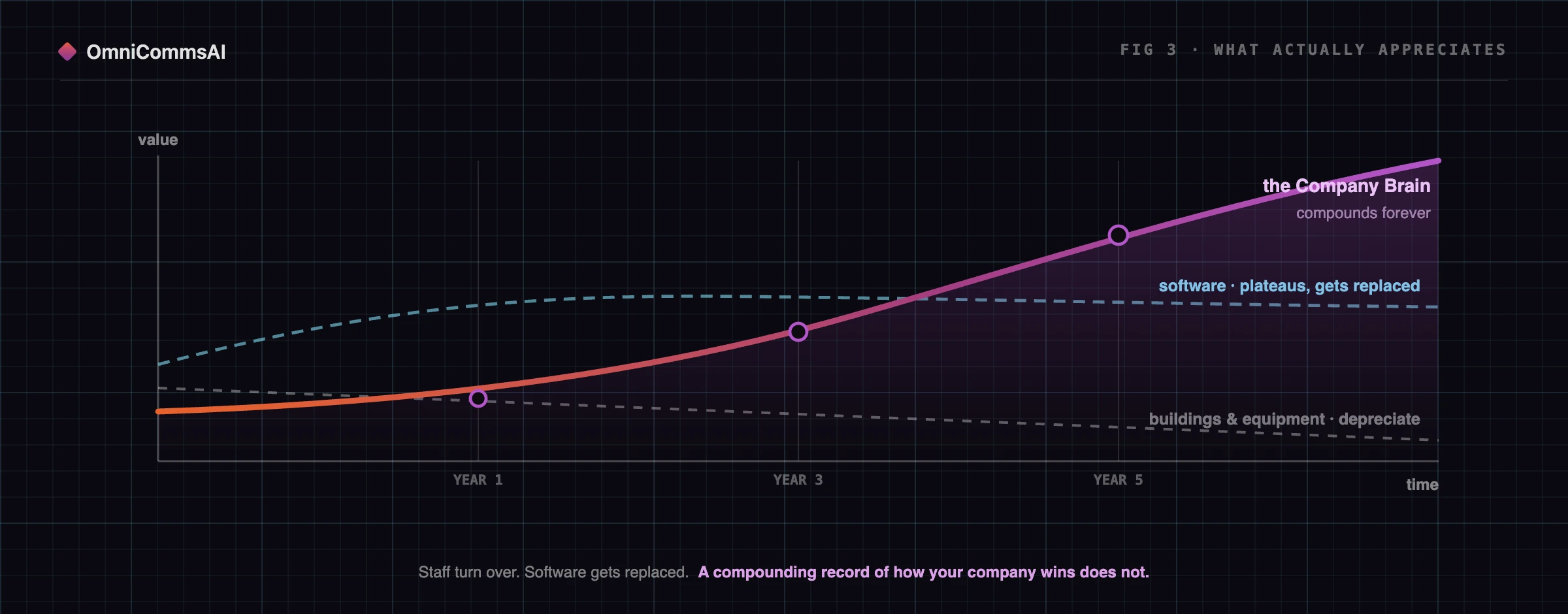
Don’t build your Company Brain inside one model vendor
Here’s the practical question that follows, and it’s less about trust than about structure.
Every frontier lab is now shipping memory, projects, assistants, and agents. It has become genuinely easy to just build everything inside one of them. Put your documents there. Have your conversations there. Let it accumulate.
Before you do, three questions. None of them are accusations.
Can you get it out? Ask what leaves with you, and in what form. If years of accumulated judgment can’t be exported into something another system can actually use, then it isn’t an asset you own. It’s an asset you rent, and the rent is whatever they decide it should be once leaving has become unthinkable.
Whose business are you funding? Their revenue is tokens and their product is the model. Every incentive they have points toward you sending more, staying longer, and their model getting better in the process. That isn’t villainy, it’s just their business. It is a different business from yours, and when your most valuable asset lives inside a company whose goals point somewhere else, you are a tenant rather than an owner.
What happens when they’re no longer the best? The model layer reshuffles every few months. Whoever is clearly ahead today has been behind before and will be again. If your brain is welded to one of them, you don’t get to switch. You will have made a permanent bet on a temporary lead.
That’s the whole thing in one line:
Your Company Brain is the constant. The model is the variable.
Models get swapped out every few months, and they should. What your company knows is the thing that has to survive every one of those swaps. Build it so the model is a part you can replace without touching the brain underneath it, and you get to use whatever is best this year without paying for it in accumulated judgment.
   BUILT INSIDE ONE VENDOR              BUILT ON A NEUTRAL PLATFORM

   ┌──────────────────────┐             ┌──────────────────────────┐
   │  their model         │             │   YOUR COMPANY BRAIN     │
   │  ┌────────────────┐  │             │   memory · judgment      │
   │  │ your brain     │  │             │   provenance · weights   │
   │  │ lives in here  │  │             └────────────┬─────────────┘
   │  └────────────────┘  │                          │  swap freely
   └──────────────────────┘                ┌─────────┼─────────┐
      export?  unclear                     ▼         ▼         ▼
      switch?  no                       model A   model B   private
      leave?   start over                                   / local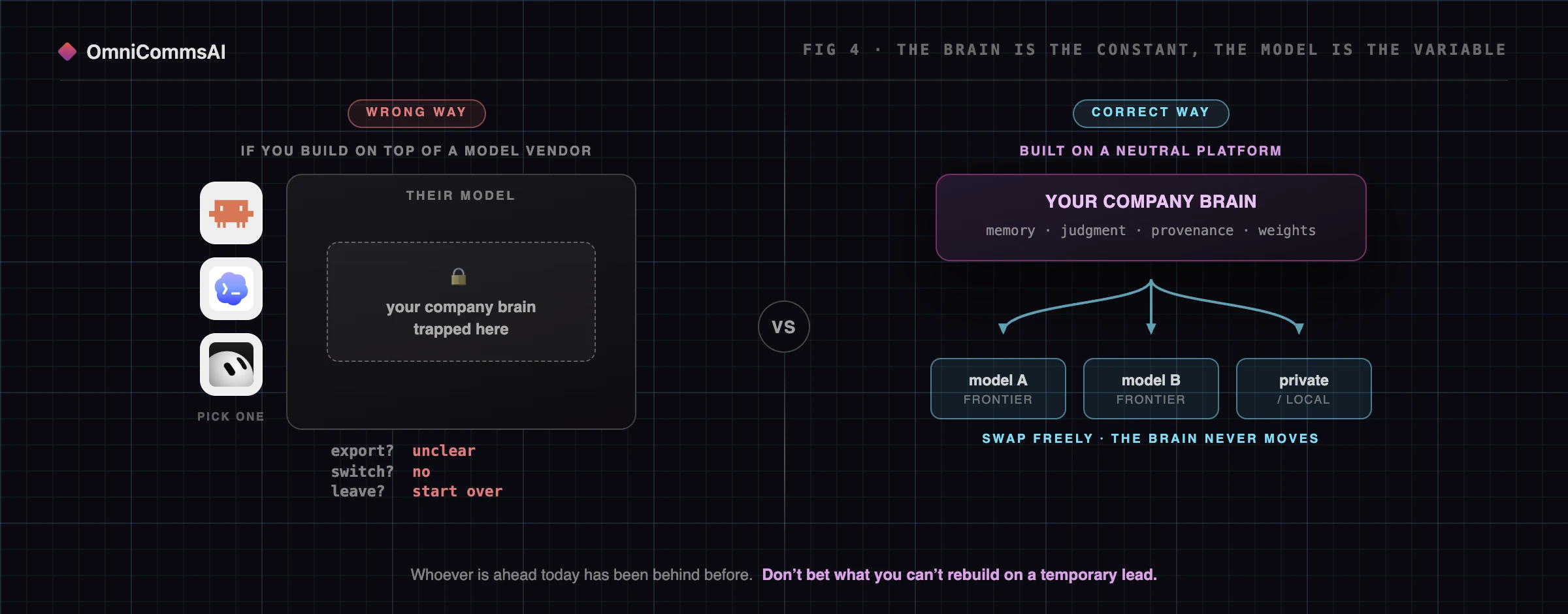
How we built it instead
Model agnostic on purpose. You build the brain with us and run it on whichever frontier model you want. Change your mind next quarter and the brain doesn’t move, because it was never inside the model to begin with. The model is a part. Parts get replaced.
You choose where the intelligence runs. You can use any of the popular frontier models, the same ones you would reach for anywhere else. Or you can run those same models through private, secured access hosted on our own AWS infrastructure, so your prompts and your corrections stay inside that boundary instead of crossing a public endpoint. Plenty of businesses start with the first and move to the second as what they’re feeding it gets more valuable.
Your own weights, eventually. The direction this goes is private local models a company runs on weights it trained itself. We’re building toward that, and being model agnostic from day one is what makes it possible to get there without a migration.
We don’t train models on your data. Not as a policy we could revise next quarter, but because it isn’t the business we’re in. We sell software to businesses. We don’t sell a model, and there’s no version of our roadmap where pooling what our customers know makes us money. That business model is the one this entire section argues against.
We’re your custodian of record. The whole product is a record of your business: your conversations, your decisions, your judgment. Our job is to hold it, keep it retrievable, and keep it yours.
The point isn’t to avoid frontier intelligence. It’s excellent, it’s getting cheaper, and you should absolutely use it. The point is that a neutral platform with no stake in which model wins is a saner place to keep the thing you can never rebuild.
The far end of that road is the interesting one: a model that reasons over your Company Brain while running on weights you own, inside your own boundary. We’re building toward it.